Showing posts with label travel. Show all posts

Tuesday, January 22, 2019

How To: Become A Travel Writer

I get a lot of messages from people asking me how to make a living as a travel writer. I was recently interviewed about my career by BossBabe. During the interview, I tried to offer some general advice about how to travel for a living and shared my personal journey as an example. 


Sarah Harvey in the Maldives

Every path is different


In addition to what I told BossBabe, everybody's personal journey to working/living overseas will be different. I began working as a journalist more than 10 years ago (as a news reporter in London) and I'm still working in journalism today, as well as doing travel writing and content creation. It's been a pleasure and a privilege to have made 100% of my income from writing for more than a decade (it wasn't easy in such a competitive industry and I've had my fair share of challenges!).

So in my case, I had a solid trade behind me (journalism) before I started out in travel writing. I began freelancing and managed to get my first travel articles published (reviews of The Zetter Restaurant & Rooms in London, a weekend in Hungary and a gastronomic tour of Alentejo, a less well-known part of Portugal. Combined with my background in news reporting, this led to a job offer in the Maldives to work as News Editor of a travel magazine and news website. So my first foray into being a travel writer was a full-time staff role. After a year I built up the confidence to go solo and founded Manta Media, an association of freelance writers, photographers and other creatives based in the Maldives.

I won't go into the long story of everything I've been doing since then, but that is how I got the ball rolling. And like I said, everybody's experience will be different, whether you want to be a travel writer as your profession, or simply do some travel writing while living overseas. But a common theme in my story and other people's stories is having a solid, transferable skill-set behind you and building up contacts, rather than diving right in and expecting work to come to you.

So, it's hard to say 'this is exactly what you should do' - firstly because there's no guarantee of success for everyone, but also, secondly - the harsh truth of it is that not everybody has what it takes to handle life overseas, even if they think they do...

Sarah Harvey in San Francisco

#Harshtruth


This harsh truth is something that many people are too scared to tell you. As I mention in the interview, a lot of people love the idea of travelling and living overseas but then find the reality can be much tougher than what they ever could have imagined. Visiting somewhere on holiday (or even shooting through a destination for a few weeks as a digital nomad) is entirely different to actually living somewhere, in all kinds of unanticipated ways. It's definitely not like 'being on holiday forever'!

For example, your mental health can take a hit due to you being away from your support network/social circle, you might struggle to make new friends, you might have unexepected health problems and find the hospitals aren't equipped to help you...

Or even something seemingly less dramatic, such as you miss all the foods from home too much and can't stand the local food (fine for a week, but punishing after a month), or can't continue with your designer shopping habit because there isn't enough selection in your new destination. These examples sound small, but I've seen people leave countries for all of these reasons, and if you'd have told them how much it would get to them before they left home they'd have sworn it would be impossible.

Ponzi schemes


This is all why I don't agree with writers selling courses and books on 'How to be a digital nomad' or 'How to be a travel writer/blogger/influencer'. There's no precise formula and just because one person succeeded one way is no guarantee that you will too.

I'm not trying to sell you anything which is why I'm telling you this. To be honest, I feel like a lot of people trying to sell these kinds of 'courses' are pretty much facilitating a digital nomad/globo ponzi scheme - 'leave your home, come travel, I'll show you how!' (Clue: Their answer is really 'by writing/selling courses that tell others to leave their homes and travel' - just like them!). Is this kind of constant hustle really the 'freedom' you dreamed of?

This kind of reality check is really lacking from social media. Most writers and bloggers I meet overseas are actually working on side gigs too, or the blogging is the side gig, despite the fact they've got thousands of followers and seem to be pretty successful on the surface.

Blogging reality check


For example, very often they might be working as a teacher and make 10% of their income from blogging, but they introduce themself as a 'blogger'. While they're free to call themselves what they want, it's a little deceptive and personally I find it irresponsible, especially when I get messages from people who believe it's an easy and viable way to make a living and you have to explain all the hard work that will go into it. A lot of people who contact me seem to want an easy answer and are disappointed to hear that there isn't one. But morally, I can't pretend there is.

Of course, there are some bloggers out there who make a living solely from being very clever with their blogs (which requires good skills in engaging with people, negotiating sponsorship deals, PPC ads, etc. and a good dose of luck!) This is the unseen stuff that takes up more time than the actual writing...I'm just not a fan of the ones that pretend they sustain a jetset lifestyle from their blog when they usually make their cash elsewhere.

And I'm not writing this as somebody who wanted to be solely a blogger above anything else; journalism is my trade, I've always loved print media (not to mention it pays better than blogging) and I like the fact that journalists are bound by a Code of Ethics that influencers/bloggers aren't bound by (influencers can say anything they like and there's no obligation for the claim to be founded in reality!).

Sarah Harvey in the Mexican Caribbean

Making it work


However, going back to my main point: I'm not saying you won't find your own way of making it work - lots of people do. Or you could consider being an ESL teacher, web developer, graphic designer, hotel staff, sommelier etc who does writing on the side.

Working full time for a newspaper, magazine or website overseas, or remotely for one or two content creation clients are solid ways of making it work. If you want to work full-time for a foreign company where you can contribute some skills that they need, you'll need to demonstrate you can do something that nobody else can do, in order to get your visa.

Join Facebook groups such as The Copywriter Club, Digital Nomads Around the World and Female Digital Nomads for inspiration. Sign up to newsletters for remote jobs or join websites for ESL work.

Read up and research how other people do it (with a certain dose of cynicism when required); formulate a plan before diving in, and you'll have a much better chance of achieving your dreams.

Thursday, December 27, 2018

Top 5 International New Year's Eve Destinations

New Year's Eve is one of the most over-hyped holidays of the year. That's why I started a tradition of bringing a group of friends to various overseas destinations to celebrate New Year's Eve in totally new surroundings with no expectations*. 


*This is not an arbitrary listicle - being the journalist that I am, I road-tested all of these New Year's Eve street parties myself!


I figured New Year's Eve would be less fraught with stress and disappointment if we plunged ourselves into a foreign country rather than trying to hit up the swankiest clubs in London and then find black cabs home amidst the chaos. We always balanced out the revelry by spending a few days either side of December 31 exploring the cities. Is the formula successful? More than half a dozen New Year's Eve trips down, I'd say so.

There's one rule that unites all of these New Year's Eve experiences: each New Year's party had to involve us joining the city's biggest street party for the countdown to midnight. So here they are...


5 Paris


Better pic than mine - New Year's Eve on the Champs Elysees: Flickr/Falcon Photography
Paris is so much fun for New Year's Eve that we went twice. The main street party is along the Champs-Elysees, between the Arc de Triomphe and the Eiffel Tower, so we decided to ring in the New Year by drinking champagne on the Champs-Elysees. The entire street fills up with crowds and at midnight everybody turns to face the Eiffel Tower which has a light display on it and a fireworks show. The crowd was extremely friendly and we ended up dancing the hokey-pokey with them.

Actual evidence of  our hokey-pokey on the Champs-Elysees
I can still remember the British Airways steward on our flight from London City Airport. The cabin was almost empty, being as we were travelling late afternoon on December 31 (London is such a short flight from Paris that we didn't need much time to prepare).

The air steward asked how we'd be celebrating and when I told him we planned to celebrate with champagne on the Champs-Elysees he disappeared then returned with a bag full of mini white wine bottles for my group of 12 friends. "Here you go - this is to make sure you celebrate in style - the flight is almost empty anyway so you may as well take them," he said. Such a nice gesture. Yep, we'll be flying with them again...!

Afterwards we found a nightclub in Pigalle and danced until 5am. The nightclubs open late in Paris (around 1am or later) so the timing works well for anyone wanting to go after counting down to midnight outside. There's an ice rink on the second floor of the Eiffel Tower if you'd like to get some skating in beforehand.

Bonus points for: Iconic views of Eiffel Tower,  number of flight connections to Paris Charles de Gaulle Airport/Orly, and the legendary British Airways steward who surprised us. 


4 Berlin

Brandenburg Gate, New Year's Eve: Visit Berlin
This was one the coldest New Year's Eve parties I can remember. The thermometer said -13c but the wind seemed to whistle right through my skull, possibly because of the cold humidity. On the plus side, it's one of the biggest, if not the biggest, New Year's street party in Europe - and one of the best! Being as it's an official street party rather than just a congregation of revellers in the street, it was extremely well set up. There are dance tents and beer and sausage stalls all around Tiergarten, running down as far as the Brandenburg Gate and the Victory Column, which you probably recognise from movies.

The only problem is no beer is allowed in the dance tents. So you have to run outside to drink a beer then run back inside to warm up by dancing again! It was so cold that the beer got slushy ice inside of it within seconds, which was an incentive to get back in the tent.
We had started the night at a legendary bar called Kumpelnest3000 (one of the kitschiest and entertaining bars in this funky city) before joining the street party, which was so good that we stayed out until the street cleaning trucks arrived at dawn.

Beer, pretzels, live music - street party!

Bonus points for: Providing free dance tents for revellers, currywurst and beer stalls, iconic views of the Brandenburg Gate. 


3 Prague

New Year's Eve in Prague: Flickr/Jan Fidler
The main point to meet on New Year's Eve in Prague is at the astronomical clock in the Old Town. It's a beautiful Medieval clock dating from 1410 and when it strikes the hour, little clockwork figures of the 12 apostles and a skeleton (representing death) move around it. There's a firework show from on top of the hill and live music in the same square as the clock, and a compere from the live music stage leads the countdown at midnight. It gets smokey really fast so you need to take your photos as soon as the fireworks start, but it looks really beautiful!

The Old Town Square, right next to the astronomical clock
The square is lined with late-night bars so there are plenty of options to choose from after midnight. We ended up at a Cuban bar (randomly) because everywhere was quite full, although the further you are from the square the cheaper it gets. The cocktails were great and it was extremely cosy inside.

Prague is extremely cold this time of year and there was snow on the ground, but it felt less cold than Berlin, perhaps because it was a drier cold.

Bonus points for: Counting down to midnight at one of the most beautiful clocks in the world, excellent Italian restaurants nearby.


2 Salzburg 


Salzburg on New Year's Eve: Pixabay
This was a wild card as a New Year's Eve destination goes. It was actually the first New Years trip I organised, and managed to round up about 10 friends for it. We had no idea what to expect, having never visited before, and it not being a big city compared to Paris or Berlin.

We gathered in Residenzplatz (a square next to Salzburg Cathedral, in the historic centre) just before midnight, where everybody was drinking beer and dancing. Most of the crowd was Austrian but I heard a few foreign accents there too. There were a handful of stalls selling drinks including 'gluhwein' which helped warm us up a lot! The square itself was very picturesque and was overlooked by the castle, which is on a slight hill.

Drinking gluhwein to stay warm on NYE
Everybody was very friendly and we were able to chat in English, French and broken German to strangers in the crowd, wish them "prost" and dance with them. The atmosphere actually got quite chaotic when some revellers started throwing fireworks and bangers around the streets and off the castle hill, and the historic monuments, but it seemed to make everybody even more excited. Perhaps the

Although it was one of the smallest crowds compared to the turnout in bigger cities like Berlin and Salzburg, it was one of the most wild, fun and friendly crowds - despite the Austrian stereotype of being rather insular and conservative. Just goes to show that stereotypes are often wrong!

Bonus points for: The welcoming crowd, proximity to Untersberg Mountain (where The Sound of Music was filmed) for skiing or just enjoying 'gluhwein' at the top of the ski lift on New Year's Day.  


1 Sydney

NYW in Sydney - Pixabay
This one had been on my bucket list for years. Not only because Australia is one of the first countries in the world to welcome in the new year, but also because Sydney's New Year's Eve celebrations are legendary. 

Before I get into how amazing it is, you need to know it takes a bit of preparation because it's such a big event. Something like 1.6 million attend the free public firework show in Sydney on December 31 and over $5 million AU is spent on it. You'll be able to tell that a lot of money was spent on it. But you need to get there early to grab a spot to stand and watch the show. And if you want to sit somewhere with a good view, you'll need to get there late afternoon/early evening (no exaggeration!) and settle in for a long wait... 

Here we are at our spot next to Sydney Harbour Bridge


We found a great spot in Bradfield Park (Milsons Point), right next to Sydney Harbour Bridge, and directly opposite Sydney Opera House. The downside was there are no drinks stalls and strict controls on alcohol, so you can't bring any with you. There are security checks and staff look through your bags, so if you want to be close to the action AND have a drink, forget joining the crowds and buy a ticket to a hotel, bar or casino party instead. 


As you can see, it was getting quite crowded even by late afternoon...

That said, there is lots of live entertainment including an air show, and when the firework show actually started...it gave me goosebumps. It was undoubtedly the best and most dramatic firework show I've seen to date (and I've seen a lot, including Fallas in Valencia!). There was a huge show right on Sydney Harbour Bridge but also one behind the Opera House that we could see at the same time, and many other smaller ones, too. 
The build-up to midnight on New Year's Eve in Sydney was excellent

The size, the shapes, the sounds...I didn't even know fireworks could make some of those shapes - it was clear a lot of money had been spent on those fireworks. It was nothing short of incredible, and by the end of it, my friends and I were literally shaking with excitement! No drinks until after midnight, but absolutely worth it. Check out the video I shot of the finale of the New Year's Eve firework show in Sydney: 


Honourable mention: New Year's Eve in Krakow (similar to Prague in terms of set-up around the Medieval clock - and the coldness!).

A truly great New Year's Eve party can be affected by the company you're with, so you might not agree with all of these choices but I've tried my best to explain what made them such fantastic places to welcome in the New Year. So this is dedicated to all my incredible friends who have joined me for New Year's Eve over the years.

Thursday, September 20, 2018

Tiburon: The Most Beautiful Part Of The Bay Area You've Never Heard About

I was lucky enough to spend a month staying with an amazing friend living in Tiburon this summer - a stunning area only five or six miles from downtown San Francisco, with unbeatable views across the Bay of the iconic city skyline, and the added bonus of a warmer microclimate (which feels like a blessing as you watch the fog roll in over San Francisco)! Living 'as a local' gave me some unique insights into this secluded and often-overlooked part of the Bay Area...


Tiburon is located on a peninsula extending into San Francisco Bay in the exclusive neighbourhood of Marin County. It's only a half hour ferry ride via Blue and Gold Fleet ($12.50 each way) from downtown San Francisco but a world away from the city. I absolutely love the Victorian architecture, funky shops, creativity and intellectual hippy vibe of San Francisco, but Tiburon is the perfect respite if you're looking for a slower pace of life.

You probably won't find a single piece of litter on the ground or see any homeless people. Instead you'll find a compact town centre consisting of perfectly manicured public streets, quaint wooden houses, fashion boutiques, wine-tasting rooms and restaurants. Oh, and the occasional deer just strolling through a carpark or casually crossing the road!

San Francisco skyline in the fog

There's even a tiny bit of nightlife in the form of an excellent bar named Sam's Anchor Cafe which stays open until the last person leaves (believe me, we tested this!). But how is it that Tiburon has gone under the radar to so many for so long for so many people except for those in the know?

Many tourists who want to avoid staying in San Francisco itself opt for the charms of the slightly larger Sausalito, which has a similar Old World atmosphere to Tiburon. Like Tiburon, Sausalito is connected to the city by ferry and cyclists seem to love it because they can do a round trip over the Golden Gate Bridge from there (admittedly with a few scary-looking road sections of the route with no cycle lanes). Being a larger town, it's better equipped for tourists and is closer to the Golden Gate Bridge (although you can see the top of Golden Gate Bridge from the peak of the hill in Tiburon).

Even Tiburon Fire Station looks like some kind of adorable toy-town building

Since Tiburon is smaller it has fewer facilities than Sausalito, and also (deliberately) the town has avoided going down the Airbnb route. There are only a handful of places you can actually stay there, the main ones being an upscale, slightly retro-looking tavern with a large (heated) outdoor dining area, The Lodge at Tiburon (around $224/night) and the Mediterranean-looking Water's Edge Hotel, right in Main Street, (around $299/night). The latter is a popular wedding reception venue.

Catching the ferry
So yes, it'd be fair to say this is an exclusive neighbourhood (I completely geeked out when I learned the amazing Robin Williams used to live here). However, that doesn't mean that the locals are aloof. Everybody I walked past on the road (with the exception of right in the centre, which is packed with day visitors) looked me in the eye, smiled and greeted me warmly. Some stopped to chat and ask where I was from (which is always difficult to explain because I've now lived in seven countries on four continents!). There wasn't an air of feeling unwelcome as a foreigner, everybody seemed pretty relaxed and happy to be living in such a beautiful and safe neighbourhood (crime is almost non-existent here).

In case you're wondering, the name Tiburon means 'shark' in Spanish. The area was named 'Punta de Tiburon' by Spanish explorers in the 1800s. It later became a major rail hub on the North Pacific Railroad. The line has been pulled up since then and turned into a lovely walking route (see below).

The highlights of Tiburon 


Main Street

Every Friday night Main Street is closed to traffic and fills up with live music and al fresco dining from 6pm-9pm. The gorgeous wooden buildings were created between 1870 and 1920. It's a short street but lovely to wander down.

Main Street, Tiburon

Old Saint Hilary's Church at 201 Esperanza Street (on the hillside)

"It looks just like something out of Little House on the Prairie!", exclaimed one of my friends when they saw my photos on Instagram. And it's true - this beautiful, gleaming white gothic church was built in 1888 and looks like it could have been in an old Western, or maybe in WestWorld! It fell out of use and was de-consecrated but the church and surrounding land was preserved by a group of residents.

Old Saint Hilary's Church

Hiking near the church

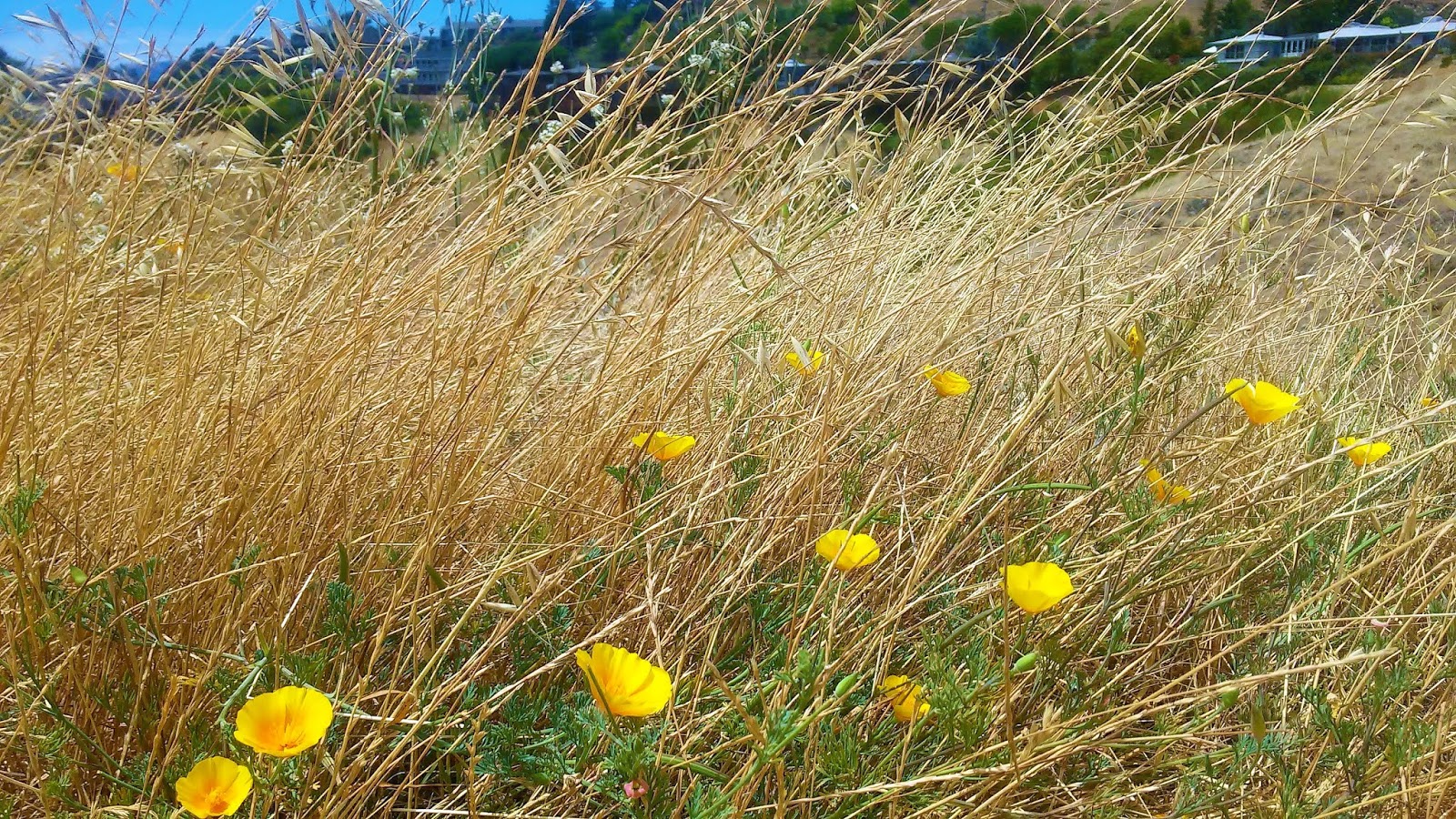
There are a number of short trails between the centre of Tiburon and Old Saint Hilary's Church, extending up over the hillside behind it. Apparently these beautiful golden hills are under threat because somebody wants to build a housing development here - let's hope that never happens, as it would be a major loss for locals and visitors alike.

Beautiful long grass and wildflowers on the hillside

Ark Row

This is a collection of huge wooden house boats that artists and other bohemian types docked at Tiburon Lagoon in the late 1890s. The inlet and much of the area was reclaimed from the sea, so nowadays these houseboats permanently grounded at the water's edge. Also check out 'the China Cabin', which is an ornate wooden ballroom rescued from a former steamer, the SS China.

Ark Row/China Cabin

Tiburon Linear Park and Blackie's Pasture

This track is much longer and more impressive than the short Shoreline Park, although the tiny Shoreline Park does offer great views of downtown San Francisco and Angel Island. Follow the former railroad tracks right from the town centre along the coastline. There are display boards along the way featuring historic photos and etchings of how the area used to look. It leads to Blackie's Pasture, which is a wide open space with a playground and picnic areas. Blackie's Pasture is named after a horse that was loved by the local community and was always seen standing surveying his kingdom. Despite being swaybacked he lived to the grand old age of 28. A statue of Blackie was erected in the field in his memory, which I thought was rather touching.

A much-loved former Tiburon resident

Tiburon Playhouse

This has to be the cutest cinema I've ever seen. It's a wooden building painted in sky blue with a white trim and has three small screens inside. Although it looks like it should be an arthouse cinema is plays all the mainstream releases.

The cutest cinema in the world: Tiburon Playhouse

Sam's Anchor Cafe

This Tiburon institution was originally opened by Sam Vella, an immigrant from Malta, in the 1920s. Rumour has it that Sam's was full operational even during Prohibition! There's a trapdoor in the floor that they used to sneak whisky through from the boats. It still has an amazing atmosphere and is particularly busy at weekends, when the outdoor terrace is crammed with people enjoying it!

The outdoor deck at Sam's fills up at the weekends!


Ferry to Angel Island

When you're looking at Angel Island from Tiburon it appears as if it's part of the headland but in fact is separated by the sea. Go cycling or hiking here, or maybe check out the museum which explains its history. It used to be where new arrivals to the USA were processed and made me wonder if my great-great-great uncle (is there another 'great in there?) who emigrated to San Francisco during the Gold Rush ever set foot here. I remember my grandmother showing me a letter he wrote from here to relatives back in Lincoln in beautiful hand-writing. There is a regular ferry service between Angel Island and Tiburon.

Angel Island is in the background, and to the far right is downtown San Francisco

There's so much more to say about what makes Tiburon so beautiful but I'm going to leave it here for now. It's definitely worth checking out, perhaps for a day trip from San Francisco, especially if you like a slower, quieter pace of life. Most of the town shuts down by 9pm, which gives you time to admire the lights of San Francisco on a clear night, or watch the fog rapidly rolling in from the sea to completely hide the city from view. 

Wednesday, November 15, 2017

Digital Nomads: If You Can't Find Your Tribe, Create One!


La Finestra pizzeria, for 1.50 euro pizzas and 7 euro bottles of wine after co-working. Photo: Lesya


Arriving in a new country, especially if you turn up alone, can be tough. After going to the usual CouchSurfing and Meetup events and making a handful of friends, I inadvertently ended up creating a new community for digital nomads and remote workers, which this week surpassed 500 members. 


I'm terrified of how easy it is for the tone of personal travel blogs to veer into self-indulgence and crash over the cliff-edge of douchecraft. So I'm not attempting to tell everyone that they must do the same as me - heck, I know not everyone likes dealing with the hassle. But I know how important 'finding your tribe' is when you're living overseas, whether you're just staying a month, a few months, or longer term. They don't have to be from the same country as you; they can be from the country you're currently in, or indeed from anywhere. But your tribe is the people you gel with; the open-minded, global types who share your values. So I'm sharing my experiences in the hope it may help bring other groups together (and yes, also promoting my co-working and social group!)....


Cafe Berlin. Shameless selfie by: Voy (who has now moved on to the Canaries with his lovely girlfriend)
I was sitting with my laptop in Costa Coffee in Valencia's Avenidadel MarquĂ©s de Sotelo, in April. (Not a bad spot for uninterrupted wifi, but a little soulless). As I took a break from what I was writing, I noticed there were three or four other people also hunched over their laptops. Their pasty skin, shorts and flipflops were instant giveaways: These people weren’t from Valencia. "I wonder if they work remotely like me…", I mused to myself as I crunched on my gritty chai latte, "…and why do I always keep ordering the lumpy chai lattes here?". 

Addressing the more pertinent of the two questions, I observed they appeared to be working rather than messing around on Facebook so concluded they were probably digital nomads too. I felt like saying hello, but something about the silence in the cavernous chain cafĂ© put me off. After I left, I wondered why I hadn’t risked a ‘hi’.  Would they have wanted to chat and work alongside me? (And would they have agreed to watch my laptop for me while I took a bathroom break? (Erm, 'hashtag digitalnomadproblems'...) 

The Solution


Joking apart, this isn't an uncommon dilemma for digital nomads and expats. Sometimes the endless whirlwind of trying to socialise and make new friends gets a bit overwhelming, and it's a relief when you finally find yourself part of a community or social group. I've found that everywhere I have lived overseas I've ended up wandering around for weeks feeling like the new kid at school, then somehow ending up organising events for everyone. I used to organise DJ nights via my Maldives Expat Parties group which involved taking up to 100 expats to resorts for 6 hours of dancing and drinking. (Getting that many drunk people home on boats was a challenge!). Incidentally, I made a video with a friend about the crazy expat life in the Maldives (above), the highlight was getting the seaplane pilots to dance on the plane wings! Then when I lived in France, I started a weekly social night called CouchSurfing Meeting in Nice, which became an official CS event. A rascally Parisian named Madani has now taken the helm. Madani has done wonders with the group, negotiating discounts and promotions at bars, and there are now 2,500 members. 


Some tips for creating a new social community overseas:  


  • Find a suitable platform, such as Facebook, CouchSurfing or Meetup
  • Gauge potential interest by asking online - see who responds
  • Make firm plans and stick to them. Don't be flaky or people won't trust you! 
  • Organise the event well. People will hold you responsible if anything goes wrong
  • There may be some complaints, learn how to use them constructively to improve the event/meetups

Back to Valencia: After my Costa experience I posed the question to the excellent Facebook group, Expats in Valencia. Within an hour I had over 50 comments! It seemed that yes, there were dozens of people like me (digital nomads, remote workers and expats) who would like an excuse to co-work and socialise with like-minded people. Two hours later, I’d started a Facebook group calledValencia Coffees and Co-working. The concept was simple: If you’re a digital nomad/remote worker in Valencia and want to meet up at a cafe for some informal co-working, I’ll suggest a time and round a group of us up. There's no charge for the meetup (since most digital nomads are characterised by their desire to save cash), so you just pay for whatever you consume at the cafe. It’s ideal for anyone who doesn’t want the commitment/expense of a co-working venue, and wants to socialise after work too. This is the first time I'd created an event involving work rather than purely for socialising (read: 'boozing'), and it seems there's a demand for it.  

Co-working at Ubik cafe. Photo: Lesya
The very first meet-up was the following day at Federal CafĂ©, which isn't too pricey and is open all day. A charming Polish programmer named Voy and an American named David (who has somehow wrangled only working a mythical 3 days per month), were the only attendees. (Well, I had only given everyone 12 hours’ notice to turn up…). Six months later, we have 500 members and more than 20 nationalities! 


Working hard at Federal Cafe. Shameless selfie by: Voy
To keep it simple, we have one meeting every Wednesday afternoon and thankfully only about 15 of the 500+ members attend each time. They are a mix of regulars and newbies, given the transient nature of the demographic. We bond over travel tales and a fondness for after-work drinks. 
Some of the other members just join us for drinks in the evening. And some of the group have joined it ahead of relocating to Valencia. (If you want to live in Valencia, read my post, 8 Reasons to Live in Valencia in your 30's!). The remainder of the group who I haven't met yet are lurkers: I still haven’t figured out what they want yet!


Ubik cafe. Wine time begins when we clock off
Members also give spontaneous shout-outs on our Facebook page throughout the week if they're working from a café and want some company. We ask questions about visas and technical issues, and share upcoming events. On top of that, we organise some fun social events which have included hiking, checking out the Wine Festival, the Vermouth Festival, and a Halloween party.

Some of the group on a 9-hour hike in June (we all survived). Photo: Voy 


Chilling out after the wine festival in April. Photo: Peter
Enjoying the Vermouth Festival in September (Yes, there is a running theme...)
Some of the gang at the beach party in May
Cecile's monthly wine tasting event, which began with a Valencian Reds theme
So far we haven't needed to reserve a table in advance at the cafes, and the owners have been more than happy to host us since afternoons are quiet, although if the attendees exceed 15 I may have to start giving them a heads-up. Usually after a co-working session (around 6pm) we clear our laptops away and are ready for wine time, which costs about 7 euros per bottle in Valencia! One of the best deals is Cafe Artysana's Happy Hour from 5pm to 7pm. 
 

Videos by Voy: That time we went canyoning in August and forgot ropes. And wetsuits. And helmets. Which everyone else we met had with them...

Don't Go Chasing Waterfalls...

The fun part usually continues for several more hours with a bar crawl and tapas, and sometimes we head to La Finestra for a pile of authentic Italian pizzas at 1.50 euros each. Occasionally it has escalated to us hitting the clubs (which may not be the smartest thing to do on a ‘school night’, but then again, Valencia is a city which parties every night!)

  Some of best cafes in Valencia for free, uninterrupted wifi:


Ubik (Cheap, spacious, funky)
Federal (Serves food all day, spacious, but not super friendly)
Jardin Urbano (Vegan, cheap and very peaceful)
Bluebell Coffee (Small tables but good food, terrace)
Café ArtySana (Very nomad-friendly, cheap, spacious, funky, 9 euro all-day brunch deal, terrace)
American Cupcakes (Quiet, smells amazing, great cupcakes for 2.50 euros)
La Mas Bonita in Ruzafa/Patacona (Amazing cakes - Red Velvet with cheesecake filling is worth killing for, nice decor, spacious)
Costa Coffee (Only this Costa branch in VLC has unlimited wifi but you must check in via Facebook for access, very spacious, don't do the chai lattes)

Halloween 2017 house party


You can follow the exploits of Valencia Digital Nomads on *Instagram. (*We promise you won't see any cliched Insta-aspirational couples holding hands)